COLLECTIVE DYSFUNCTION
The animal sense of belonging is long gone.
Since humans began to think, we developed ideas and beliefs to find safety in our newly developing, abstract understanding of life. But now, the mutually confirmed beliefs and identity of our traditional cultures have collapsed.
Over this last century, even the secure identity of inherited family trade and work skills has vanished.
We imagine our modern education provides us all with freedom of thought to meet the modern challenges of life. But most people are left with only a surface appreciation of constructive thought and questioning. So typically, we stop thinking at the first explanations which are socially confirmed and emotionally gratifying. And herd mentality spreads like a virus.
By exclusively focusing our culture has produced a need to always be going somewhere, doing something, and believing in something; a feeling of being incomplete which is only filled by addictive routines and habits, we have produced a self-righteous closed-minded form of individuality.
In this condition it's an effort to be socially empathic. And so we needed to create morality and ethics, rights and laws.
And recently, all our codes of work, play, etiquette, and mating habits, and the possibilities of how to break those codes, have rapidly diversified and multiplied. The rights and laws can't keep pace.
A chaotic state in our herd mentality – our collective social identity – has developed.
Our modern fight for survival has transferred to the abstract dimension of rights, beliefs, ideas, and opinions.
The Rich Tapestry
So now, if we want to achieve a society of free individuals, then we need to follow Gandhi and Mandela; we have to learn their lessons on forgiveness and respect for all beliefs.Without embracing the entirety of humanity, our modern collective psychology lacks integrity. Rejoicing in the rich tapestry of life is something the best of us agree on and aim at.
Our modern liberal thinking to contain the diversity of beliefs – rather than infallible rulers forcing a consensus of ideas – is a great step for civilisation.
And, i believe this is truly the best option our exclusively focused understanding of life can offer.
But the fragmentation inherent in focusing is relentless. The colours in our rich tapestry are always multiplying, becoming more extreme and more abstract. Extreme opinions will always contain some form of prejudice against people who disagree. The aim of believing in ourselves is leading to self-righteousness. And not everyone agrees with Gandhi.
And we accept it, even when we don't like it we accept that this chaos is happening and think there's nothing we can do about it.
Why are we so blind to pahanal reality?
This or something like it is what we could expect from a culture which only looks for understanding and safety by focusing.
How on earth could we ever hope to develop a feeling for the common good – without sensing life as whole?
Abstract Reality
It's not our essential nature or any higher principle which dominates modern social thinking – it's how we identify ourselves, whoever we think we are, our abstract and projected individual image.A comedian bought it on the point when he couldn't get served at a drive-in burger cafe because he was on foot, so he told them "I identify as a car".
Our Projected Image
Quite generally in modern society, projected images are the form in which human individuality is recognised and acknowledged.
This took form with industrial mirrors around 1850, when our common self-image rose from the murky depths of reflections in water to a vivid practical everyday experience of self-reflection. And a century later we could record and pre-record our reflected image.
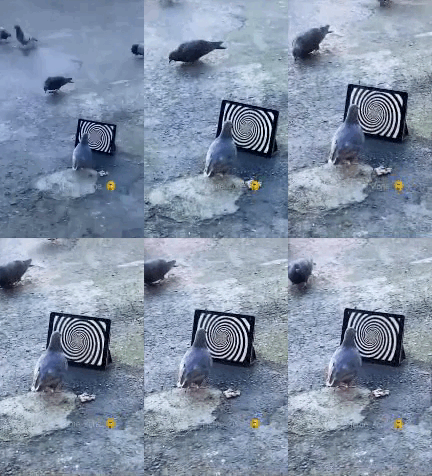 It's so normal that we don't notice but television through to social media, are abstract images. They are projections on a screen. It's not real, it's got quadratic corners... at best it only replicates reality as sensed by focusing.
What we're looking at, listening to, and understanding, is a representation of reality which is developing incredibly quickly – fragmenting and reconstructing – and becoming more abstract.
In 2011 image filtering (to show what you would look like if you were the opposite sex, or another species, or with perfect make-up), started on Snapchat and Instagram. In 2024, AI started producing its surreal images of human identity.
And even if we don't indulge in any of these modern image enhancements personally, they're all around us.
And again the point is, we accept it even if we don't like it, we accept this is happening and think there's nothing we can do about it and – apart from years of discipline with body awareness exercises, such as the internal taste of our own bodies – there is little that we can do by focusing.
Image Worship
We are entering a modern new-age of self-centred image worship – an individual form of our forefathers' idol worship.We have an abstract image of ourselves, which we try to believe in and then celebrate socially. And it's basically the same situation early man was in – it doesn't matter much if it's the actual truth, as long as it's socially confirmed and emotionally gratifying.
There are a fascinating variety of psychological conditions which this generates; and we could spend centuries analysing all the curiosities.
But the central energy and confusion – the search for identity and purpose – is still coming from the age-old question of "Why am I?".
We are overwhelmed by the self-perpetuating momentum inherent in focused learning. We are overfocusing.
Even when it's subliminal, we're habitually, psychotically focusing – wanting to do something, go somewhere, think something, and essentially to be someone.
To continue on this path will lead to stupidity, anxiety, and ultimately insanity.
Securing Our Survival
This is all such a hopelessly pessimistic view of modern civilised man that it would be unmentionable – except for the solution that if we want safety, peace, and a feeling of wholeness and belonging, then we need to learn how animals do it.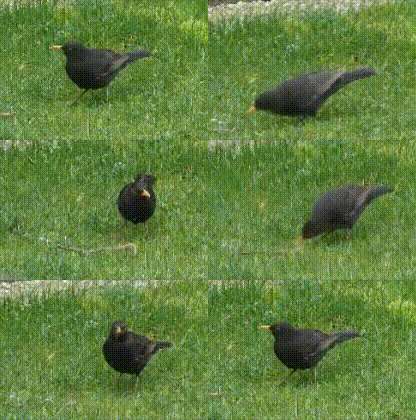 All the time we're ignoring part of our essential nature. We have inadvertently suppressed part of our basic awareness and intelligence – reality as experienced pahanally.
The panoramic connection with the environment neutralises any need for self-realisation, self-belief, and even self-identity.
It opens up a whole new world. There's no sense of the abstract, and no question about "why am I?". We can experience just being and a sense of wholeness.
Yes, we need a purpose in life, we need focal points, but we also need to coordinate or alternate them with periods of pahanal sensing.
We need short interruptions to the continuous routine mechanics of the ego and its projections. Short experiences of pahanal reality and realising the limitations of our habitual abstract subject-object consciousness, our thinking-knowing consciousness, the endless thinking-doing routine.
It's a totally different way of being, sensing, experiencing, and understanding humans and life. And, it's no coincidence that this is also how all other animals stay safe.
Pahanal reality is a sense of the attitude of other people, the volume and tone of their voice, (the colours they wear, their shape and size, the speed and direction they move, the sound of their shoes) – it never even considers what people say or how they identify on an abstract level.
Pahanal reality is a moment of being without wanting to be or do anything except feel the satisfaction of being pahanal and connected with the environment.
The pahanal experience isn't a new religion to identify with, we don't have to believe in it for it to work. It's not even really a skill, though humans may need to think along these lines to relearn it.
It's a natural way of being, something animals just do without even thinking about.
It's been tried and tested by animals for billions of years – it is clearly part of a successful method to survive. Every animal uses it. Every animal except humans.
Please continue with Human Potential
Back to Chapter Three : Civilisation's Habitual Ruts
Back to THE PANORAMA SENSES Priority Pages