SURVIVAL STRATEGIES
Panoramic sensing is a receptive all-round awareness. Its primary use is to guard against danger.
Focusing evolved to select specific objects or small areas. Animals use it to do all the things they need or want.
A Fundamental Common Sense
Life started panoramically. Every amoeba has chemoreceptors (for 'smelling and tasting') and a generalised sensitivity to light and vibration.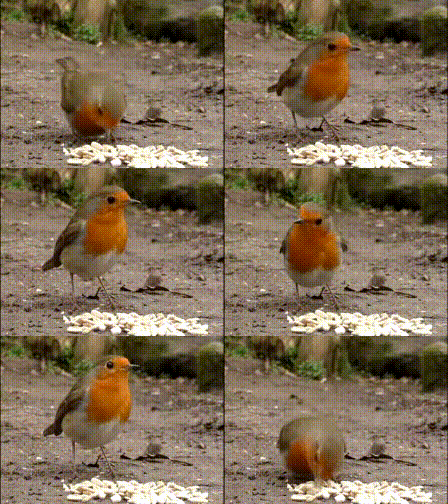 Most birds have a sensitivity to ultraviolet light; a quick panoramic glance allows them to detect any threatening life-forms.
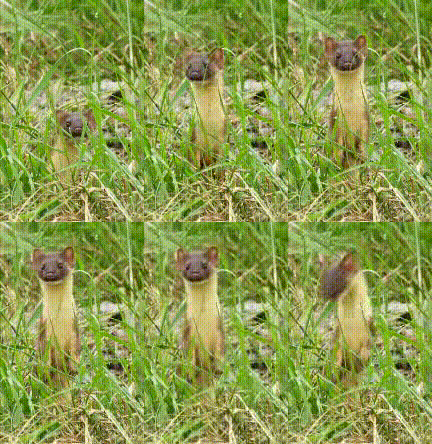 Land animals must stay still and watch, listen, and smell for a few seconds, to detect movements and changes.
This isn't mindfulness. Mindfulness is focused.
It's a very direct way of experiencing life. Throughout evolution, it's been the natural way to stop doing or wanting anything, and be actively receptive.
It's not like a form of multi-tasking, or focusing on lots of different points at the same time. It's far simpler.
In panoramic reality, our senses connect us with all we're sensing as a whole – and against this ordinary, regular background we're able to instantly notice all the sudden little changes and signs of life.Animals have been using their senses in this way for billions of years.
Vulnerable animals alternate panoramic and focused sensing.
Predators, when they're hunting, combine the two.
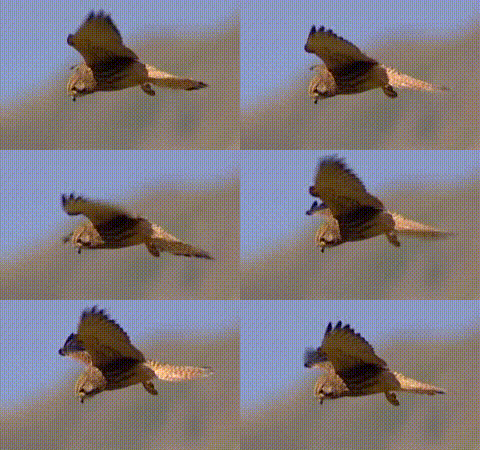 Predators generally watch over a middle sized area, a stretch of water or a field. This waiting and hoping phase usually lasts several minutes. It's motivated by focusing – wanting to catch prey.
The Human Experiment
Focusing is a perspective on life with hidden depths.
First focusing divides life into bits, then focused thought makes associations to join the separate bits together again in relationships.
We developed an astounding ability to think and understand these relationships – to focus on memories and to learn.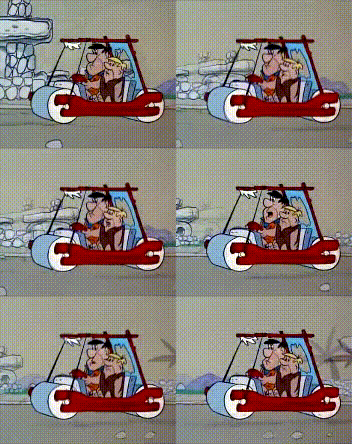 We learnt how to shape flint tools, to make fire, and wheels, to read and write, and gradually our modern civilisation developed. Focusing can be amazingly clever and creative – it does things, and it gets things done.
Humans reasoned out cause and effect, learnt and then acted and achieved results. This gave us a purpose in life, a sensation of wholeness and satisfaction.
Since childhood we have so much to learn, that our early education of focused doing and thinking overwhelms our panoramic abilities before they can even start developing.
Our only knowledge of panoramic sensing comes from the subliminal use of the horizontal peripheries when driving, to alert us to something we might need to focus on.
Animals would become extinct if they only ever focused.
Beliefs and Wholeness
Humans found that having belief in a relationship with the spirit worlds, resulted in a wholesome, satisfying sensation.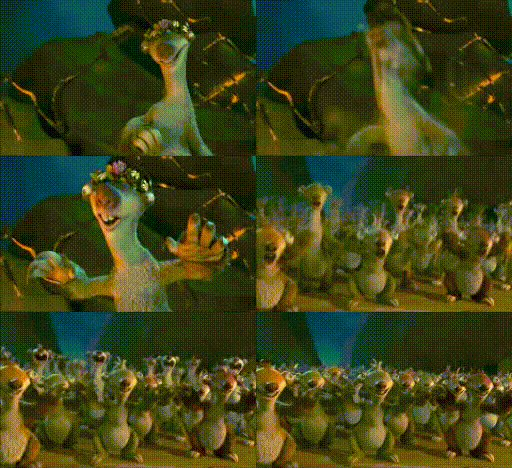 Beliefs are the epitome of focusing. They are inspiring, often perfect focal points.
Beliefs are probably civilisation's greatest achievement. For hundreds of thousands of years spiritual beliefs were at the centre of human life. They gave us identity, purpose, and a deep – almost animal – sense of belonging in our community.
And slowly our understanding has given us new beliefs on equality and freedom – the value of each individual and freedom of thought.
Consequently, the unquestioned security of our traditional beliefs vanished and we lost the security of a family trade and inherited social position.
Self-discovery, believing in ourselves, and realising our dreams all sound wonderful – but they often lead to self-deception and self-righteousness; and even lying criminals can realise dreams and believe in themselves.
Our focused experience is limiting our understanding.
Civilisations' Neurosis
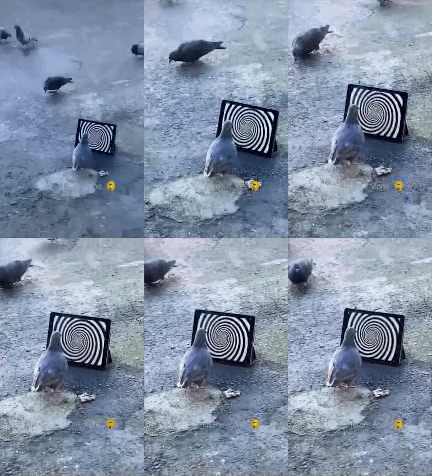
We either go round and round in circles, or ask new questions. But every new level of abstract understanding reveals new questions. It's like a dog chasing his own tail.
Every sentence we think supports the idea that subjects need objects to feel whole – the focal point, the centre of our focused world, is each individual and to be complete we need a relationship.
And, we can't stop thinking. One thought associates with the next automatically and because everyone else is doing the same, we think it's natural. It isn't. It's neurotic. It's an illness only humans have.
Our modern, intense early training and education of concentrated focusing has turned off the off-switch.The Off-Switch
 Wanting anything is impossible without focusing on it.
Without focusing we can't join thoughts together.
It's a state of consciousness where egoism is not possible.
It's a selfless state of being, but, we still have the free-will to focus instantly whenever life needs a reaction or response.Focusing gives us the idea that life consists of doing, wanting, and subjects relating to objects in order to feel whole. It's vital to realise that this is closed minded – it's only one perspective on life.
The Safety of Being Open
Safety and security for civilised humans is found in beliefs and relationships, closing off behind walls, laws, and our own constantly repeating inner dialogue."Safety by openness" sounds irrational. But this feeling is normal and natural with panoramic openness.
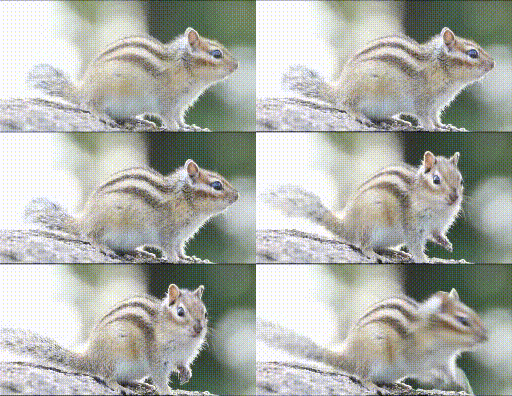 The main reason panoramic sensing developed among animals was to stay safe out in the middle of life – by being totally open to the entire, unpredictable environment.
It's in touch with all it senses as a whole – it's a state of wholeness.
And now, these days, humans have a great advantage – we don't need to fear lions or snakes, and we don't need to escape every time we see a cat or dog.
With panoramic sensing, modern humans can experience safety and even peace of mind by just being panoramically open to everything around us.Our continuous focusing has created a massive blind-spot.
At present, we never find peace of mind because we're continuously thinking. And we've learnt that without an understanding of relationships, there's no hope of wholeness.
 We are missing out on a natural feeling of wholeness and the opportunity to balance out what is becoming an inreasingly focused, polarised, and divided reality.
Basic Mental Health
Beliefs and ideas are necessary in order to have an identity and feel like an individual with a reason to live – with something to do, a direction and purpose.This has immense value, but to want both individuality and wholeness at the same time is unnatural.
Panoramic openness interrupts the neurotic patterns of thinking and wanting which are causing the pace of modern life to overrun us.
Every single panoramic moment helps needs and wants, thoughts and actions to clarify and realign. The regular experience of openness, safety, and wholeness, brings peace of mind.
Most ancient and modern therapies and meditations can help us to develop our hidden potential; bring our lives back in balance; and give us a feeling of belonging. But, nothing is as direct, fundamental, practical, easy to do, and less expensive(!) than panoramic awareness.
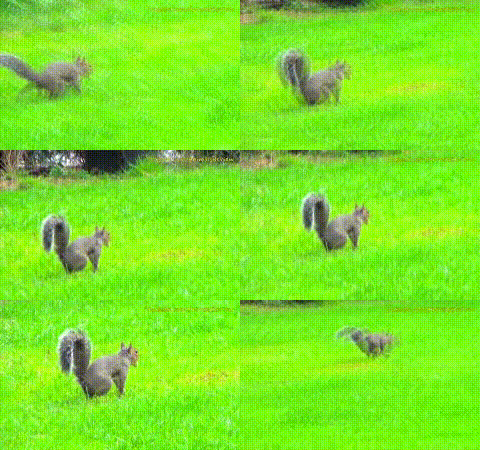 We've forgotten the panoramic experience of wholeness and safety.
This isn't a belief, animals don't have to believe in it for it to work. It's not a theory or philosophy. It's nothing glamorous or clever. It's ages old and just practical.
Human children are born with this way of sensing. Panoramic openness is a potential which we have collectively learnt to ignore.
We're neglecting the panoramic way of holistic sensing and feeling whole.
Beliefs and ideas are a product of focusing and they only lead to a feeling of wholeness with commitment to an intricate relationship, or – as they did in ancient times – if everyone around us confirms the same ideas.
This is influencing everything – politics, religion, humanity... everything.
Beliefs and relationships are essentially good, but they are far better when all the parts are whole in themselves.Please continue with Witness Report