THE INVOLUNTARY EGOIST
Humans are not by nature individualists and egoists. Throughout history we lived for an 'ultra ego in the sky'. For thousands of centuries, our beliefs supported the cultural priority of doing things for the common good.
But now, the mutually confirmed beliefs and identity of our traditional cultures have collapsed.
Over this last century, even the secure identity of inherited family trade and work skills has vanished.
Now we have to 'find ourselves' on a practical and spiritual level.
Finding and Believing in Ourselves
The main modern challenge to all educators and parents, is to help us discover and develop what we want to do and who we want to be.Being a fulfilled individual and believing in ourselves are primary modern cultural ideals – "you are unique, a special individual", "believe in your dreams". And inevitably, new-age gurus are talking about self-realisation.
These ideas are part of our herd mentality, probably the only thing we still all agree on.
It's so normal that it seems to make sense. But it's ridiculous.
This feeling which is 'me' is being understood as a result of only ever focusing with our senses and our minds. We can't even imagine any other way to experience life.
Over the ages countless philosophers have told us that the self and it's ego are illusions − impermanent, and therefore not the real self.
The practical point is that our modern sense of self and ego is unintentional and involuntary. It has developed without us realising what we were doing.
Finding ourselves, believing in ourselves, self-fulfilment, and self-realisation all sound wonderful, but focused sensing is self-centred, it has developed tunnel vision in its own abstract world.
Believing in ourselves and our individuality are incredibly limiting ideals. Even a criminal or megalomaniac can believe in themselves and be an authentic individual. Fullfiling our potential as human beings would be a far healthier and more realistic ambition.
How Focusing Understands Life
Focusing is always a selected specific narrow perspective, it separates life into specific individual bits.One of the consequences of this, is that in order to find a sense of wholeness, we need to make associations to join the bits together again in relationships.
This approach to life is embedded in every sentence we think: verbs relate subjects to objects.
Focusing condems us to a world of seperation and subsequent reintegration.
Movement, Change, and Confirmation
Every sentence we think – whether intention or opinion, statement or question – describes action, something happening, movement or change; or it validates identity, confirms and reconfirms our self-image and world-view.
And we need to act on at least some of our ideas to fulfil the sensation of purposeful living. Our thoughts guide our lives.
So, first verbs drive us to action – and then they confirm the state of wholeness (or drunkness) we've achieved.
Egoism
The way our focused sensing experiences and understands life, it was inevitable that eventually – apart from those we truly love – each individual would become their own central focal point.
But, this individual and social situation is the result of a sensory imbalance. I actually think it's a malfunction, we're stuck in a closed circuiting system, trying to establish and confirm an abstract idea, our individual identity. And because everyone else is doing it, we accept it.
We have unintentionally become closed-minded. We have hardly any consciousness of pahanal reality and never actively use our senses pahanally.
Greed
Once we started to develop this very self-satisfying sensation of independent individuality, it created an energy of self empowerment. It gave us hope for our own pleasure and security. It promised purpose and reasons. It created want.
In previous times, only the rich or privileged could indulge in their independent individuality, now it's commonplace, now everyone wants it.
We keep chasing after the next focal point, the next missing piece in our satisfaction puzzle (even if it's only to get more drunk).
We consider it as natural and normal, but it's pathologic, in the sense of it being uncontrollable, compulsive, addictive. And it's chronic, it gets more extreme with time.
Focusing always leads to increasing specialisation, then re-integration and accumulation. This applies to all the things we possess, our ideas, and our sense of ourselves.
The self greed neurosis is only barely reigned in by empathy for others suffering (and social morality and laws).
We are dominated by focused sensing and thought. And we're oblivious to the way any sensible animal would react when confronted by uncertainty and insecurity.
Any sensible animal would just stop still, go pahanal, wait for long enough to notice what's going on around, and check for danger.
Vicious Circles
The best of us feel we have to fight greed and closed-mindedness, encourage intelligence and creativity, or find and believe in ourselves. And all these are consequences of focused sensing.Free-thinkers tell us to let go of attachments, posessions and selfish desires, aim for the pure self, give up greed, pride, and narrow-mindedness. But what we are blindly and unintentionally holding onto is focusing.
We are trying to solve our problems by using the same methods which got us into this mess in the first place.
From this perspective, the one pointed, concentrated focusing methods used in many meditations are especially ironic. Concentrating on a focal point automatically encourages all the mechanisms associated with focusing.
But this is life as we know it. We don't remember there is a pahanal way of sensing life.
What we are as humans is so much more than what we can understand by focusing.
Essentially we don't need less selfish egoism in our modern lives, we need the regular experience of openness and wholeness.
Wholeness and Openness
Pahanal reality is whole, just being without wanting or knowing.
What it lacks, is a sense of individual purpose and identity. And also any need for individual purpose and identity.
Our identity won't disappear, our sense of purpose and meaning in life won't vanish, it'll just be secondary for a moment, not compulsively repeating its own habitual routines all the time.
The majority of meditation methods which stop doing anything and sit still – typically focus on the breath or body, prayer, or a higher energy, and the aim is some sort of self-realisation. Organised religion is organised around focal points.
The pahanal attitude – to stop focusing but keep the eyes and ears open to experience life as a whole – is completely missing. We have forgotten this natural behaviour, this natural response to insecurity.
Pahanal sensing evolved because it was the most efficient way to be open and aware of the whole environment. It had two clear functions, to find food and to avoid danger. As animals evolved, finding food became easier by focusing. But to for avoid danger, nothing works better than an all round pahanal sensitivity.
And this intensive, life-saving pahanal state which vulnerable animals need to use is selfless – it has to be. We can't want or think anything at the same time, it's impossible. If we started focusing on anything, we would instantly lose our pahanal awareness.
It's vital to periodically sense life selflessly in its wholeness.
Squirrels Don't Have Paradoxes
Pahanal sensing is an alternative way of sensing, experiencing and understanding. We will always come back to focused thinking to understand what's happening. And that's good and natural, these two ways of sensing evolved to balance each other and live successfully.
Focal points are essential in order to get anywhere, do or think anything, but for any focused activity to be safe and wholesome it is essential to coordinate it with pahanal openness, as all other animals do.
Philosophers and poets may think that the focused and pahanal worlds are a form of duality or paradox. Such theories are the fruits of focused sensing.
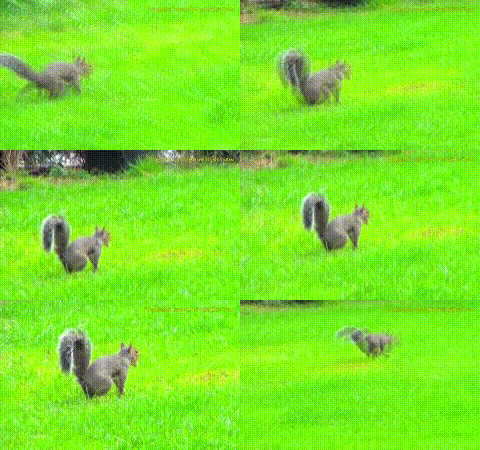 This isn't a theory, it's practical, it's clearly demonstrated by every other animals' behaviour – watch any squirrel stop for a few seconds on the lawn.
And, this isn't a belief... Animals don't have to believe in it to do it. They just do it. It isn't really even a skill. It's simply something we were all born with which has been ignored by our elders and supressed by our teachers.
It's easy. Every animal has the ability to sense life as a whole, and pre-emptively wait for any possibility of a warning sign – still, receptive, anticipating and open, ready and waiting.
This is another way of looking for answers... this is another way of looking at everything.
We have forgotten this way of sensing the world and being in it. Mankind has lost part of how we always sensed the world around us, part of how life managed to survive and evolve over millions of years.
Please continue with Safety and Beliefs
Back to Chapter Three : Civilisation's Habitual Ruts
Back to THE PANORAMA SENSES Priority Pages